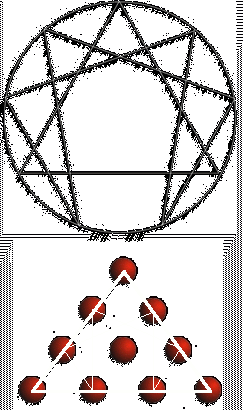

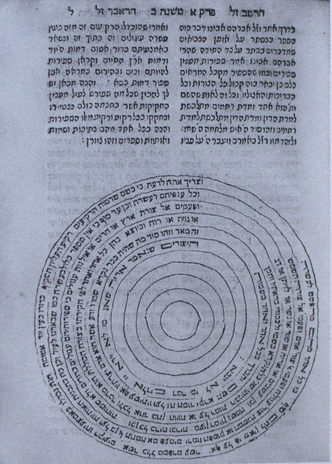

In this essay I discuss the Sefer Yetzirah in light of some fourth way ideas. The exposition here is by no means exhaustive, but represents an approach to the Sefer Yetzirah—an approach that I believe is productive.
The Sefer Yetzirah (meaning "Book of Formation" or "Book of Creation") is a text written down almost 2000 years ago that is generally considered the first of those texts that came from the pervasive influence known as Kaballah. Kaballah itself cannot be defined, as it surfaced in Jewish, Islamic, Christian, alchemical, astrological, and other traditions, always interpreted in light of the particular manifestation.
Because of the wide range of kaballistic texts, it is tempting to "return to the source"; tempting, but at least in the case of available texts, not possible. The Sefer Yetzirah exists in multiple, often contradictory versions. There is a short version, a long version, and others, although none are more than about ten pages. I was torn between using the shortest version: the "Short" version; and the oldest known version: the "Saadia" version. The shortest version because it seems to me that often ancient texts get added to over time so the short version may be closest to the source. That is not a certain thing, however, as things can be taken out or lost as well. So the Saadia version tempts me, but seems sometimes too long, as if later commentary is being included. So I use the Short version, but refer to the Saadia version when the Short version seems garbled. (I'll point out those few cases when I take something from the Saadia version.) I'll occasionally use another translation of the Short version, that by Knut Stenring, when I feel it can throw light on a difficult passage.
As a general summary, the Sefer Yetzirah introduces the idea of "ten sefirot", and the term "sefirot" (plural "sefirah") itself is variously translated as text, number, or something else, including left untranslated.
Fundamental to the Sefer Yetzirah is number, and number in three particular groupings: three, seven, and twelve. Together these quantities sum to 22, the number of letters in the Hebrew alphabet, which is used throughout the text to explain properties of the groupings. Hebrew, like other sacred languages, assigns numerical values to letters, so number and letter are intimately related. This inevitably leads to "numerology", where the numeric value of a word, for example a name, is considered significant. It also leads to complete lunacy if one is not careful, and I choose to use number values of letters very little in the way of explanation.
That Gurdjieff was knowledgeable about Kaballah is known. But as you already must realize, there is Kaballah and there is Kaballah, and getting to the heart of the matter is not trivial. The fourth way is not Kaballah, although it may be that at certain times Kaballah was an expression of the fourth way. If we recognize the fourth way as alive, ancient texts that relate to it may be seen as signposts along the way, signposts that may be decipherable with fourth way knowledge and may, in turn, lead to new insights. The following should be a demonstration of this.
The versions of the Sefer Yetzirah to be discussed here are the "Short Version" and, occasionally, the "Saadia" version. As non-identical copies of each of these versions exist, bracketed text [] indicates additional text from another copy of the same version. Text from the Sefer Yetzirah is in the left column. My comments are displayed on the right in turquoise text.
This first chapter begins (Part 1) with the discussion of the ten numbers. Then, in a transitional section (Part 2), it shows how these numbers give rise to the 22 letters. (The following chapters 3—6 then deal with the letters.)
| Chapter 1, Part 1 | |
| 1. With 32 wondrous paths of Wisdom engrave Yah, the Lord of Hosts, [God of Israel, the Living God, King of the Universe, Almighty God, merciful and gracious, High and Exalted, dwelling in eternity, whose name is Holy, and create His universe] with three books, with text (Sepher), with number (Sephar), and with communication (Sippur). | This paragraph summarizes the whole book—from the One ("Lord of Hosts") comes the Three ("text", "number", and "communication"), ultimately creating 32 ("32 wondrous paths of Wisdom"). |
| 2. Ten Sefirot of Nothingness plus twenty two [foundations] letters: Three Mothers, Seven Doubles, and Twelve Elementals. |
The "32" comes from adding 10 to 22. These are the basic 10 numerals, and the 22 letters of the Hebrew alphabet, used to form all numbers and words. The "10" correspond to the One—they are virtual ("nothingness") aspects or qualities of the activity of the One in creating the "22"—"Three Mothers", "Seven Doubles", and "Twelve Elementals" (3+7+12=22). |
| 3. Ten Sefirot of Nothingness: The number of the ten fingers, five opposite five, with a single covenant precisely in the middle, like the circumcision of the tongue and the circumcision of the membrum. | The One from which the ten come is invisibly at their center. | 4. Ten Sefirot of Nothingness: Ten and not nine; ten and not eleven. Understand with Wisdom, and be wise with Understanding. Examine with them and probe them, make a thing stand on its essence, and make the Creator sit on his base. | Understanding and wisdom are emphasized to be distinct here. The imperative of the translation seems to demand mental activity on our part, as opposed to passive acceptance. Understand—actively contemplate, based on your accumulated and refined experience, wisdom. | 5. Ten Sefirot of Nothingness: Their measure is ten which have no end. A depth of beginning, a depth of end; a depth of good, a depth of evil; a depth of above, a depth below; a depth east, a depth west; a depth north, a depth south. The singular Master, God faithful King, dominates them all from His holy dwelling until eternity of eternities. | The ten define the infinite universe— temporal, moral, and spatial—controlled by the One. | 6. Ten Sefirot of Nothingness: Their vision is like the "appearance of lightning", their limit has no end. His Word in them is "running and returning". They rush to his saying like a whirlwind, and before His throne they prostrate themselves. | This is the light of the universe, and perceived as such, all in service of the One. The ten virtual qualities may be perceived in the light of consciousness, but it is the One they serve. | 7. Ten Sefirot of Nothingness: Their end is embedded in their beginning, and their beginning in their end, like a flame in a burning coal. For the Master is singular, He has no second. And before One, what do you count? | It begins with One and it ends with One. All is contained in One, because multiplicity is division, not multiplication—He has no second. | 8. Ten Sefirot of Nothingness: Bridle your mouth from speaking and your heart from thinking. And if your heart runs, return to the place, as it is written, "The Chayot running and returning" (Ezekiel 1:14). Regarding this a covenant was made. |
Control your behavior by controlling your attention, which is running and (hopefully)
returning. This is emulation of the divine—as your attention runs and returns, so
too do the active functions go out and return to the One.
Understand—control your attention to actively contemplate divinity based on your best understanding. This increases understanding which returns, increased, to further enable your active contemplation. This is the divine process of regeneration. This is a promise, a deal. A covenant was made. |
| [Chapter 1, Part 2] |
At this point in his commentary on the "Gra" version of the Sefer Yetzirah, Aryeh Kaplan
says "According to some critical studies, this line is the end of the most ancient part of
the text." While I don't have access to those critical studies, I find this very
interesting because, in my interpretation, this point marks the fundamental division in
the discussion. Thus far we have been discussing the 10 ineffable sefirot. From now on, we
will discuss the Creation of the cosmos. The point we are at is given no special emphasis
by the structuring of the text—it is simply near the end of
a chapter.
Note that now we are going to begin to count, One, two, and so on... First, the consciously creative Three is created. |
| 9. Ten Sefirot of Nothingness: One is the Breath of the Living God, blessed and benedicted be the Name of the Life of worlds. Voice, Breath and Speech. This is the Holy Breath (Ruach HaKodesh). |
We are now going to follow the descent of the ray of creation where One acts on two to
create three and so on, or the triad carbon-oxygen-nitrogen which is the process of
creation, or growth.
The mention of "Breath" seems odd here. As we will see when we study this text further,
the ancient elements of Fire, Water, and Air (Breath), are used in a manner consistent
with the fourth way terminology active, passive, neutral, respectively (or carbon, oxygen,
nitrogen). Consistent except here. Here we are told that the neutral force (Breath or Air
or "nitrogen") is initiating the triad of creation, when it should clearly be Fire (active
force or "carbon"). While the author (Kaplan) I am using translates this word as breath,
another translation (Stenring) has the following text for this passage:
Ten ineffable Sephiroth: One—The Spirit of the Living Elohim, His Throne is erected in eternity.Elsewhere, where Kaplan translates a word to "Breath", Stenring consistently uses "Air", which makes me suspect that Kaplan's use of Breath (or his source) in this passage is incorrect. With Stenring's translation of "Spirit", we get an active force at the beginning of the triad we are now discussing, which must be correct, as the process of growth, including the ray of creation which is being discussed here, begins with the active force (1-2-3). |
| 10. Two: Breath from Breath. With it engrave and carve twenty-two foundation letters - three, Mothers, seven Doubles, and twelve Elementals - and one Breath is from them. | Two in order of density, but three in order of creation. This is Air, between Water and Fire. This is neutralizing, the resultant. Collin's "Form". More on this after the next verse. |
| 11. Three: Water from Breath. With it engrave and carve chaos and void, mire and clay. Engrave them like a garden plot, carve them like a wall, cover them like a ceiling. |
This is Water, the fathomless void, passive force. Thus the first triad has been created. This first triad is World 3 in the ray of creation. Now the ray of creation proceeds by the process of creation or growth, in the order 1-2-3, or active-passive-neutral, or carbon-oxygen-nitrogen, or fire-water-air, or whatever terminology we use (and we are about to be introduced to still another terminology using letters of the Hebrew alphabet). Yet, in the discussion we have the sequence Spirit-Breath-Water, instead of Spirit-Water-Breath. The order used here, for the first triad, World 3, is not temporal sequence but rather order of density. This is quite correct because temporal sequence makes no sense in World 3 where there is no time. In World 6, which we will be discussing shortly, time is of the essence, but here the only distinction between forces is something more fundamental, its basic property or relative "density". |
| 12. Four: Fire from water. With it engrave and carve the Throne of Glory, Seraphim, Ophanim, holy Chayot, and Ministering Angels. From the three establish His dwelling, as it is written, "He makes His angels of breaths, His ministers from flaming fire" (Psalms 104:4). |
So the first triad is complete and now the next one begins. The first triad supplies the active principle (correctly labelled Fire now) to the world below. This next world, created by the first world (the first triad or World 3), is going to be World 6, and here we will see a whole new order of laws, because time and space enter in world 6. Note: It would seem that this step should read "Four: Fire from Air", not "Four: Fire from Water". This relates to the following discussion in In Search of the Miraculous: C, O, N retain their numbers 1, 2, 3. 'Carbon' is always 1, 'oxygen' is always 2, 'nitrogen' is always 3. But being more active than 'oxygen', 'nitrogen' enters as the active principle in the next triad which it enters with a density of 2. In other words 'nitrogen' has a density of 2 and 'oxygen' a density of 3. Since "nitrogen enters as the active principle in the next triad", the Sefer Yetzirah should read "Fire from Air", yet it reads "Fire from Water". It is unclear why this is so. It is possible that the names Air and Water have a different correspondence thus far than they will in the rest of text, specifically that Water is neutralizing and Air is passive. This would make the preceding discussion of Spirit-Air-Water identical to the sequence 1-2-3, which is the triad of creation, and my comments regarding density as being most important would be out of place. The trouble with this is, as I say, the rest of the document specifically equates the forces fire, water, and air as active, passive, and neutralizing respectively (see for example Chapter 3 verse 3). One possibility is that there is something unusual, even illegitimate about this case in which the next triad is generated by water instead of air as it should be. This is evocative of many Gnostic traditions in which at precisely this point, Sophia, for example, begets creation without active force, in error, out of ignorance. |
13. Five: With three of the simple letters seal "above". Choose three and place them in
His great Name: YHV. With them seal the six extremities. Face upward and seal it with YHV.
|
This is remarkable. Here, where the six processes should be, we see exactly the way the
six processes are generated from the Three. Sequential ordering of the three forces in
time create six possibilities:
If, for example, we take "Y" to represent active force, "H" to represent passive force, and "V" to represent neutral force, we have the six different possible orders of the three forces. These are the six laws of World 6. Later in this text (Chapter 3, verse 8), there will be an explicit assignment of each of the three forces to a letter of the process and we will be able to exactly associate each of the six processes with a letter sequence. Despite the very economical presentation of this chapter so far, we have a far-reaching explication of the first three worlds of the ray of creation. Paragraph "12. Four" above, described as Fire (the "seventh" process), comes from the previous triad (World 3), and then the six processes are listed. As I've pointed out elsewhere (see for example, The Six Processes, and Seven), the so-called seventh process is the manifestation of world three in world six, or more generally the manifestation of a higher world in a lower one. In the planetary representation, for example, the higher world, the seventh "planet", is the Sun. We can now see how the original ten sefirot of Chapter 1 are generated: the first triad (1, 2, and 3) generates 4 which is "fire", or the highest part of the following world which includes the next six for a total of seven. The triad plus the seven is the ten. |
| 14. These are the Ten Sefirot of Nothingness. One is the Breath of the Living God. Breath [from Breath], Fire [from water, and the extremities], up, down, east, west, north and south. |
This seems garbled. It should be a summary at the end of the chapter but only accounts for 9 of the 10 sefirot. Stenring's translation reads: These are the ten ineffable Sephiroth: one—the Spirit of the living Elohim; two—Air form Spirit; three—tWater from Air; four—tFire from Water; Height, Depth, East, West, North and South. So not only are all ten Sephirot summarized, but "Spirit" is correctly translated where Kaplan uses "Breath". (You may be wondering, at this point, why I just don't use Stenring's translation instead of Kaplan's. I may do so at some point but, disregarding for the moment the time required to replace it, in many ways the Kaplan translation is more "friendly", using for example "God" rather than "Elohim" etc.) |
| 1. Twenty-two foundation letters: three Mothers, seven Doubles, and twelve Elementals. The three Mothers, A M Sh, their foundation is the pan of merit, the pan of liability, and the tongue of decree deciding between them. | The pans mentioned here are the two pans on a weighing scale. (The Hebrew letters A, M, and Sh are discussed in detail in the next chapter.) |
| 2. Twenty-two letters: Engrave them, carve them, weigh them, permute them, and transform them, and with them depict the soul of all that was formed and all that will be formed in the future. | Fundamental law determines all that flows from them. |
| 3. Twenty-two foundation letters: They are engraved with voice, carved with breath, and placed in the mouth in five places: AChHO, BVMP, GYKO, DTLNTh, ZSShRTz. | Possibly referring to chanting/breathing exercises. |
| 4. Twenty-two foundation letters: They are set in a circle as 231 Gates. And this is the sign: There is no good higher than delight (ONG), and there is no evil lower than plague (NGO). |
Note that the G in Hebrew (as in Greek) is the third letter of the
alphabet, our "C". If O=passive, N=neutralizing, and G=active, then the
first trigram, ONG is the process of healing (here described as delight),
and the second trigram, NGO, is the process of corruption, (here described
as plague). This usage is identical with the fourth way's usage (but "C"
is used for "G").
This assignment of the same forces to the same letters also holds if, and this will be my only excursion into numerology here, we relate the higher numeric value of the letter assigned in Hebrew to a greater density where O=70, N=50, G=3.) In his book, Kaplan at this point goes into a long discussion on the subject of creating a "golem", an artificial life form that the great Kabbalistic masters were said to be able to create. But the whole subject of creation of a Golem is nonsense, based on a misunderstanding of a biblical passage in which Abraham and some of those with him were said to take with them "the souls that they had made" (Genesis 12:5). Students of the fourth way should have no trouble understanding the idea of creating a soul and it has nothing to do with golems. If you create a circle with 22 points, 231 lines are required to connect all points with each other (the formula for determining this is number_of_lines = n(n-1)/2.) |
| 5. How? Weigh them and transpose them, Aleph with each one, and each one with Aleph; Bet with each one, and each one with Bet. They repeat in a cycle. Therefore, everything formed and everything spoken emanates in one name. |
Stenring's translation of this verse is very different:
How did He combine, weigh, and exchange them? A with all and all with A; B with all and all with B; G with all and all with G; and all of them turned around. Hence they go forth through two hundred and thirty one gates, and thus it comes about that the whole creation and all language proceed from one combination of letters. The idea being that a few fundamental elements can create the infinite variety of the world. But once again, three letters, in this case the first three letters of the Hebrew alphabet, are used as an example. |
| 6. Form substance out of chaos and make nonexistence into existence. Carve great pillars out of air that cannot be grasped. This is the sign: One foresees, transposes, and makes all creation and all words with one Name. And a sign of this: Twenty-two objects in a single body. | This refers to the idea of cosmos, any and every cosmos being constructed of the 22 elements represented here as letters of the Hebrew alphabet divided into groups of three, seven, and twelve. This is represented by the ennegram as the triangle, the web figure, and the 12 crossings they make. One gives rise to three which leads to all, represented by 22. |
| 1. Three Mothers, A M Sh: Their foundation is the pan of liability, the pan of merit, and the tongue of decree deciding between them. | Here again we will deal with three forces, in this case designated as the Hebrew letters A, M, and Sh, representing neutralizing, passive, and active respectively (the triad of regeneration). This will be made clear towards the end of this chapter. These three forces were historically referred to as the "elements" air, water, and fire, again respectively. (I put "elements" in quotes because I once again ran across somebody's benighted understanding in an article I was reading the other day in which the author pitied the poor ignorant ancients who thought there were only four elements and today we know there are over 100! This is a good example of formatory thinking: the author equated the ancient elements with the modern elements because we use the same word for each.) |
| 2. Three Mothers, A M Sh: A great, mystical, concealed secret, sealed with six rings. And from it emanate fire and water, separating themselves as male and female. Three Mothers, A M Sh, are their foundation, and from them are born the Fathers, from which everything was created. |
The usage of "three Mothers" and "three Fathers" here is interesting,
and would seem to contradict a statement a few chapters later that states
"Three Mothers which are three Fathers". Both are true, depending on
the point of view. In this case, they are called "Mothers" as opposed
to their source, the Father, and as their offspring generate the rest of
the world. The actual means of the creation is the six processes, that
is the three laws of world 3 and the three additional laws of world 6.
Once world 6 exists, creation can proceed mechanically. The six rings
that conceal the three Mothers are the six processes.
Fire, associated with the male, is the active force; and water, associated with the female, is the passive force. |
| 3. Three Mothers, A M Sh, in the Universe are air, water, and fire. Heaven was created from fire, earth was created from water, and the air decides decides between the fire and the water. | Heaven is active, earth passive, air neutral. |
| 4. Three Mothers A M Sh, in the year are fire, water, and breath. The hot is created from fire, the cold is created from water, and the temperate from breath decides between them. | Hot is active, cold passive, temperate neutral. |
| 5. Three Mothers, A M Sh, in the Soul are fire, water, and breath. The head is created from fire, the belly is created from water, and the chest, created from breath, decides between them. | Head is active, belly passive, chest neutral. |
| 6. Three Mothers, A M Sh: Engrave them, carve them, permute them, and with them seal three Mothers in the Universe, three Mothers in the Year, and three Mothers in the Soul, male and female. | As above, so below. |
| 7. Make Alef king over breath, bind a crown to it, and combine one with another. And with them seal air in the Universe, the temperate in the year, and the chest in the Soul, the male with A M Sh, and the female with A Sh M. | Alef (A) is associated with the neutral elements. When permuting the three letters, two sequences (A M Sh and A Sh M) begin with A. |
| 8. Make Mem king over water, bind a crown to it, and combine one with another. And with them seal earth in the Universe, the cold in the Year, and the belly in the Soul, the male with M A Sh, and the female with M Sh A. | Mem (M) is associated with the passive elements. When permuting the three letters, two sequences (M A Sh and M Sh A) begin with M. |
| 9. Make Shin king over fire, bind a crown to it, and combine one with another. And with them seal heaven in the Universe, the hot in the year, and the head in the Soul, the male [with Sh A M] and the female [Sh M A]. |
Shin (Sh) is associated with the active elements. When permuting the three letters, two
sequences (Sh A M and Sh M A) begin with Sh.
This completes the introduction of the three forces and their association with the six processes. This can be represented as a 3x2 matrix:
     A M Sh   M A Sh   Sh A M
     A Sh M   M Sh A   Sh M A
The order in which they are introduced is Alef, Mem, and Shin. That is, the two permutations beginning with Alef are given first, then the two that begin with Mem, then the two that begin with Shin. In addition, Alef is associated with Breath (Air), Mem with Water, and Shin with Fire. In fourth way terminology, this is the order Nitrogen, Oxygen, Carbon; or neutralizing, passive, active. This is also the way the first triad given is ordered (A M Sh). This triad is the process of regeneration. In addition, the triads of forces (processes) are related to "male" and "female" as in the statement "the male with A M Sh, and the female with A Sh M", in other words, keeping the same starting force and swapping the next two forces:
To summarize, we have:
|
| 1. Seven Doubles, BGD KPRT: Their foundation is life, peace, wisdom, wealth, grace, seed, dominance. Each has two sounds: B-Bh, G-Gh, D-Dh, K-Kh, P-Ph, R-Rh, T-Th. A structure of soft and hard, a structure of strong and weak, double because they are transposes. The transpose of life is death, the transpose of peace is evil, the transpose of wisdom is folly, the transpose of wealth is poverty, the transpose of grace is is ugliness, the transpose of seed is desolation, the transpose of dominance is subjugation. | The seven letters discussed here have two pronunciations, making each of them a "double". |
| 2. Seven Doubles, BGD KPRT: Seven and not six, seven and not eight. Examine with them and probe from them, make each thing stand on its own essence, and make the Creator sit on His base. | |
| 3. Seven Doubles, BGD KPRT, parallel the seven extremities. These are the six extremities: up, down, east, west, north, south. And the Holy Palace precisely in the middle upholds them all. | Here we see the basic relationship of six and seven, or the six processes to the law of seven, where the seventh is indicated by a point in the middle of the six around it. This is the same arrangement as in many symbols including the tetractys, enneagram, Hopi altar, tree of life, and so on. |
| 4. Seven Doubles, BGD KPRT: Engrave them, carve them, combine them, as planets in the Universe, days in the Year, and gates in the Soul. From them engrave seven firmaments, seven earths, seven weeks. Seven is therefore beloved under all heavens. | Examples of the seven "in the universe" are introduced here and specified in the next seven sentences. |
| 5. [How? Make Bet king over life, bind a crown to it, and with it depict Saturn in the universe, Sunday in the Year, and the right eye in the Soul. | |
| 6. [Make Gimel king, bind a crown to it, and with it depict Jupiter in the Universe, Monday in the Year, and the left eye in the Soul. | |
| 7. [Make Dalet king, bind a crown to it, and with it depict Mars in the Universe, Tuesday in the Year, and the right ear in the Soul. | |
| 8. [Make Kaf king, bind a crown to it, and with it depict the Sun in the Universe, Wednesday in the Year, and the left ear in the Soul. | |
| 9. [Make Peh king, bind a crown to it, and with it depict Venus in the Universe, Thursday in the Year, and the right nostril in the Soul. | |
| 10. [Make Resh king, bind a crown to it, and with it depict Mercury in the Universe, Friday in the Year, and the left nostril in the Soul. | |
| 11. Make Tav king, bind a crown to it, and with it depict the Moon in the Universe, the Sabbath in the Year, and the mouth in the Soul.] | |
|
Note that this does not correspond to the way we
usually associate planets with days of the week. For example, our
Saturday is associated with Saturn, our Sunday, with the Sun. But the
order of the planets is traditional—it is the way the ancient planetary
spheres were ordered (outermost to innermost) as shown here:
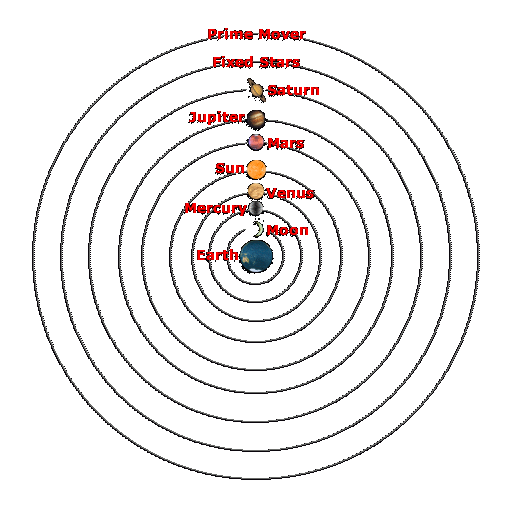
This order is counter-clockwise on the enneagram, so the letter combinations would be arranged as such:

|
|
| 12. The Seven Doubles, how does one permute them? Two stones build two houses, three build six houses, four build 24 houses, five build 120 houses, six build 720 houses, and seven build 5040 houses. From there on go out and calculate that which the mouth cannot speak and the ear cannot hear. | That three permute to six was discussed in chapter 3. |
| 1. Twelve Elementals: HV ZCh TY LN SO TzQ. Their foundation is sight, hearing, smell, speech, taste, coition, action, motion, anger, laughter, thought, and sleep. Their measure is the twelve diagonal boundaries: the north-east boundary, the south-east boundary, the upper-east boundary, the lower-east boundary, the upper-north boundary, the lower-north boundary, the south-west boundary, the north-west boundary, the upper-west boundary, the lower-west boundary, the upper-south boundary, the lower-south boundary. They continually spread for ever and ever. They are the Arms of the Universe. |
Twelve Elementals: HV ZCh TY LN SO TzQ. Engrave them, carve them weigh them, permute them,
transpose them, and with them depict the twelve constellations in the Universe: Aries,
Taurus, Gemini. Cancer, Leo, Virgo, Libra, Scorpio, Sagittarius, Capricorn, Aquarius, and
Pisces; the twelve months in the Year: Nissan, Iyar, Sivan, Tamuz, Av, Elul, Tishrei,
Mar-cheshvan, Kislev, Tevet, Shevat, Adar; and the twelve directors of the Soul: two
hands, two feet, two kidneys, the spleen, the liver, the gall bladder, the hemsess, the
kiva, and the korkeban.
How does one permute them?
|
I have not spent much time with the twelve. Here or elsewhere. It may be that a knowledge of the 12 months of the Jewish year and the 12 letters of the Hebrew alphabet here related to the astrological signs has some meaning but I have seen so much nonsense connected with zodiacal astrology that I skip it, at least for now. The main point to be made here is we are discussing world 12, which is as far as this book's descent of the ray of creation takes us. |
| 3. Three Mothers which are three Fathers, from which emanate fire, breath and water. Three Mothers, seven Doubles, and twelve Elementals. |
Here we see the basic difference between the three and seven:
So we have: Three, which are simultaneously male and female as well as each other; Seven, which can be male or female; and Twelve, of which six are male, six female. This is expressed by the author using the Hebrew alphabet as follows:
Incidentally, this entire discussion of three, six/seven, and twelve illustrates the chief difference between worlds six and twelve. World six, created consciously, is directly influenced by the world above it (world 3), which acts as another law in it, so we have seven. But world twelve, generated mechanically from world six (as all further worlds will be generated), does not have the direct participation of the higher world in it, so it is twelve and not thirteen. This text, with its "seven doubles" first alerted me to the dual nature of the seven, and I have since found it mentioned frequently in ancient texts. An example of such references is in Macrobius's commentary on The Dream of Scipio, in which he describes how the soul being born descends downward through the seven (ancient) planetary spheres, acquiring each planet's characteristic for a positive seven; and at death the soul ascends in reverse fashion through the spheres, dropping each characteristic in turn, for a negative seven. In gnostic writings, we find frequent mention of both the positive and negative aspects of the planets - sometimes only one or the other. In the gnostic creation myth of the Corpus Hermeticum, we find first the creation of the seven essence types which is then followed by the division into two sexes. In architecture, for example at the Temple of Luxor in Egypt, we find seven pairs of pillars. This, like so much "pagan" knowledge, was adopted by the Christians, and the seven pairs of pillars in the cathedral were said to represent the fourteen stages of the cross. (1) |
| 4. These are the twenty-two letters which are founded by the Blessed Holy One [Yah, YHVH of Hosts, God of Israel, the Living God, high and exalted] dwelling in eternity, whose name is Holy, exalted and Holy is He. |
| 1. Three are the fathers and their offspring, seven are the planets and their hosts, and twelve are the diagonal boundaries. And the proof of this, true witnesses, are the Universe, the Year, and the Soul. He decreed Twelve, (Ten), Seven and Three and He appointed them in the Teli, the Cycle, and the Heart. The three are fire, water, and breath: fire above, water below, and breath, the decree that decides between them. A sign of this is that fire upholds water. Mem hums, Shin hisses, and Alef is the decree that decides between them. |
The twelve diagonals are said to be the 12 diagonal lines on the tree of life. Perhaps
also the 12 diagonal lines formed when all the points of the tetractys are connected. And
the twelve crossings of the enneagram's web with the triangle.
I'll insert one "tree of life" diagram here. This is from the Gra version and appeals to me
because of its relative simplicity:
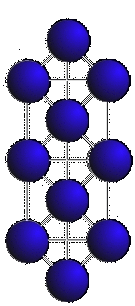
For reference, here is a tetractys (and one drawn with connecting lines) 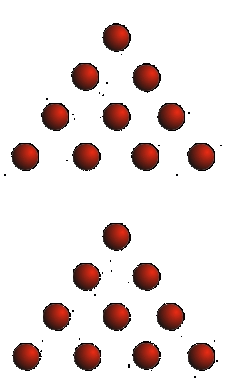
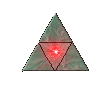
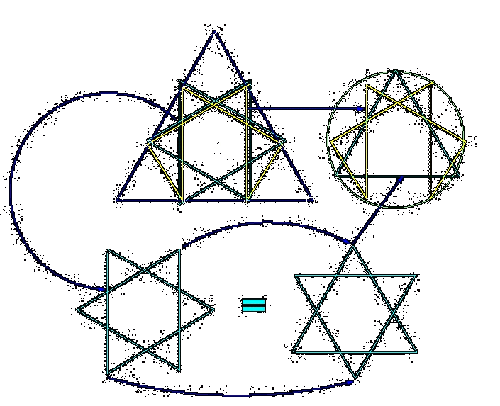
The following diagram shows some simple symbol transformations initiated by connecting the same six points of the tetractys in two different ways to generate a Star of David and an enneagram web. Again we see how the seventh point, although not shown in either the Star of David or the enneagram, would be in the center ("three opposite three, with a decree deciding between them" as we will soon read):
|
|
2. The Teli in the Universe is like a king on his throne, the cycle in the Year is like a
king in the province, the Heart in the Soul is like a king in battle.
"Also every desire, one opposite the other was made by God" (Ecclesiastes 7:14). Good opposite evil, good from good, evil from evil. Good makes evil recognizable, and evil makes good recognizable. Good is kept for the good, and evil is kept for the wicked. |
|
| 3. Three: Each one stands alone. Seven are divided, three opposite three, with a decree deciding between them. Twelve stand in war: three who love, three who hate, three who give life, and three who kill. The three that love are the heart, the ears and the mouth; the three that hate are the liver. the gall bladder, and the tongue. And God, the faithful King dominates them all. One over three, three over seven, and seven over twelve, and all of them are bound, one to another. |
"Three: each one stands alone"—the triangle. "Seven are divided,
three opposite three, with a decree deciding between them"—this is
the standard way the seven are illustrated in the enneagram, although
the seventh is typically invisible. ("Three opposite three" is well
illustrated by the theory of essence types where the maximum attractions,
which do not combine, are opposite each other, left and right, and "a
decree deciding between them" - the solar type in the middle, which may combine
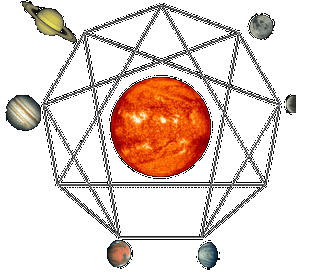
with any of the other six, on the enneagram.) So "One over three"—
the circle over the triangle; "three over seven"—the triangle over
the web and its center; seven over 12—the web crossing the triangle
at 12 points (here shown on the scale of the solar system):
|
| 4. And when Abraham our father gazed, he looked, saw, delved, understood, engraved, carved, permuted and depicted, and he was successful. And the Master of all, Blessed be He, revealed Himself to him, and took him in His bosom, [kissed him on the head, and called him, "my Beloved"]. He made a covenant with him between the ten toes of his feet-this is the covenant of circumcision-and between the ten fingers of his hand-this is the covenant of the tongue. He bound the twenty-two letters to his tongue and revealed their foundation. He drew them in water, burned them in fire, agitated them with breath. He ignited them with seven planets, and directed them with twelve constellations. | And, finally, the point of the whole thing. This knowledge is intended to be used to grow in being, and so create higher understanding. |
In the temple at Luxor the seven pairs of pillars are arranged like this:

All pages © Copyright John Raithel